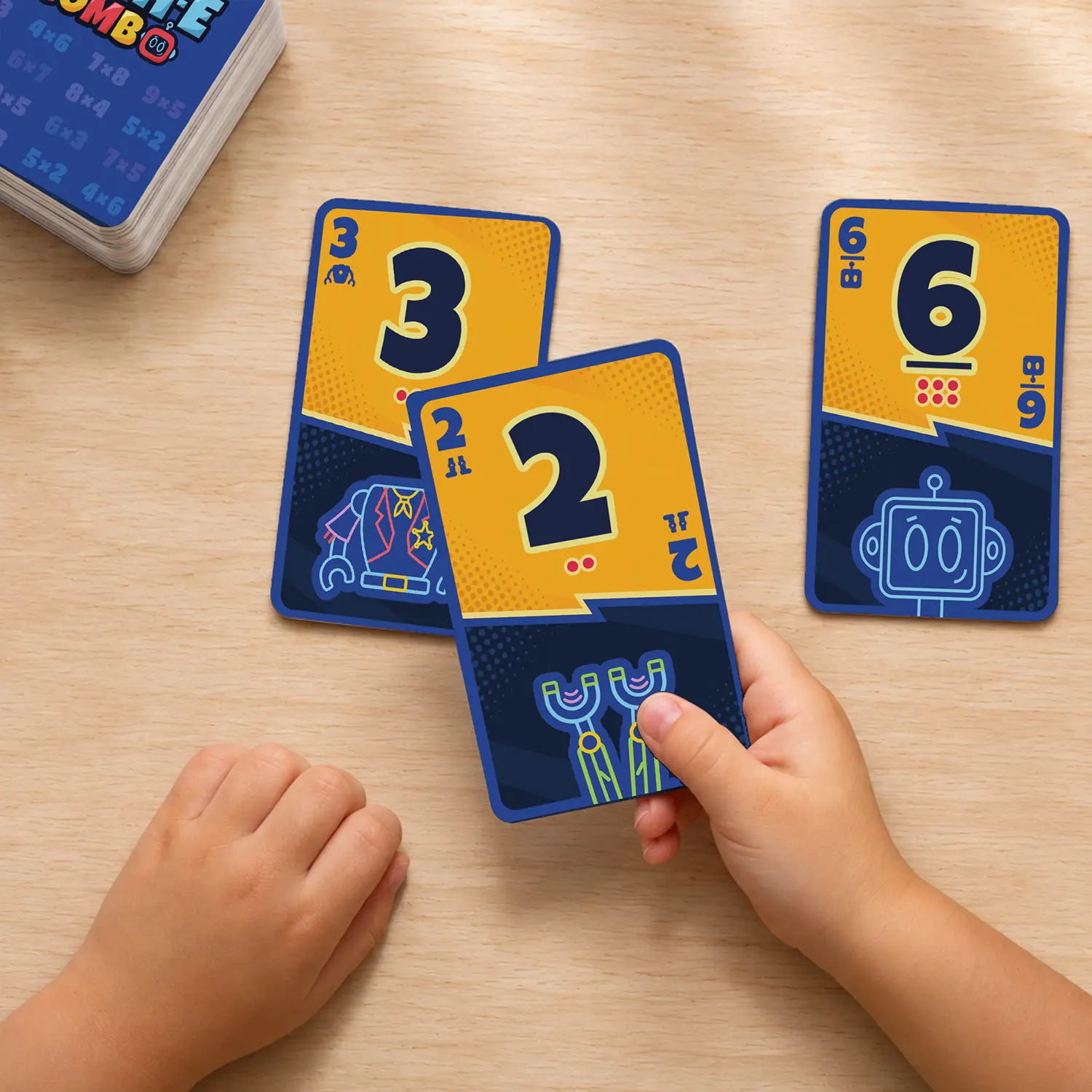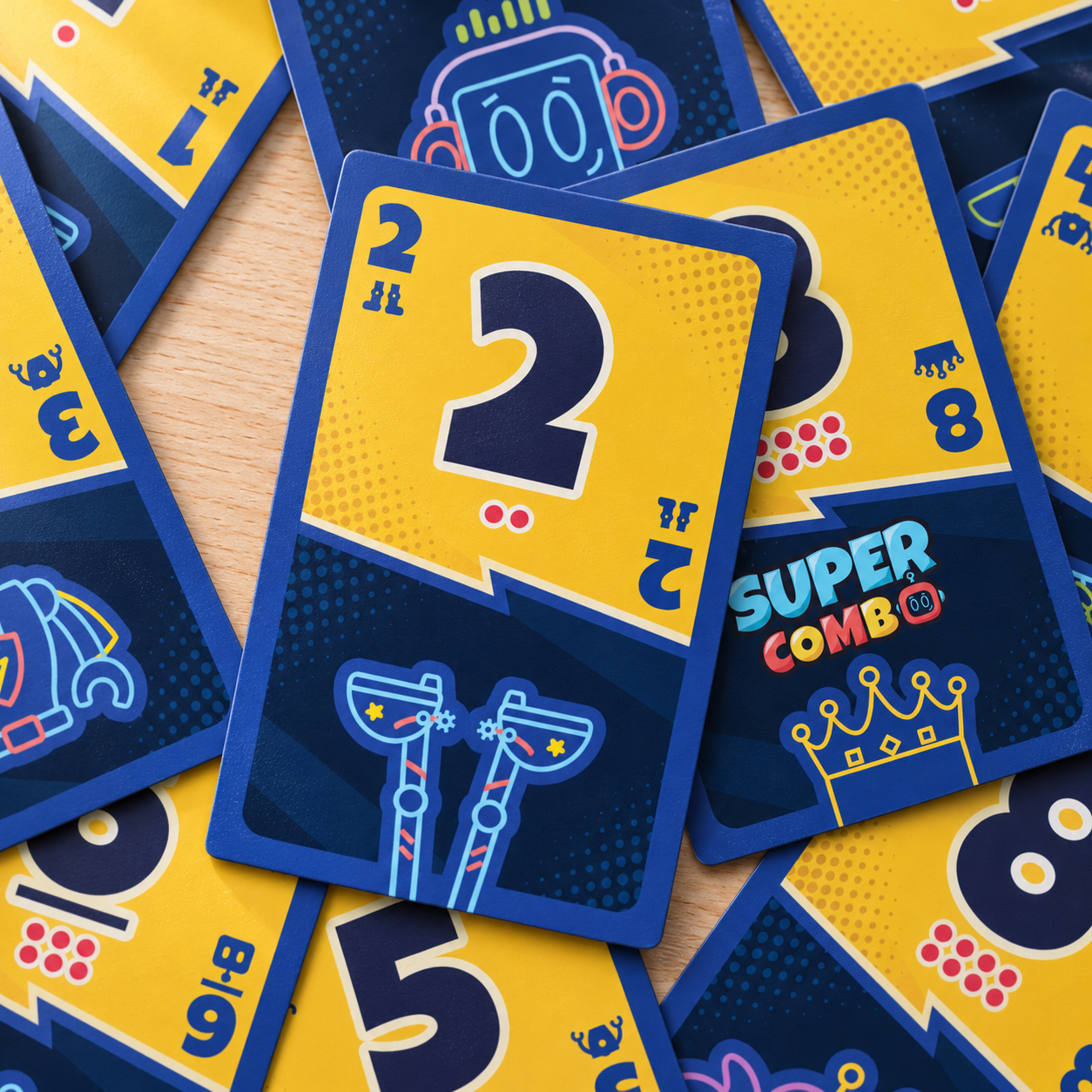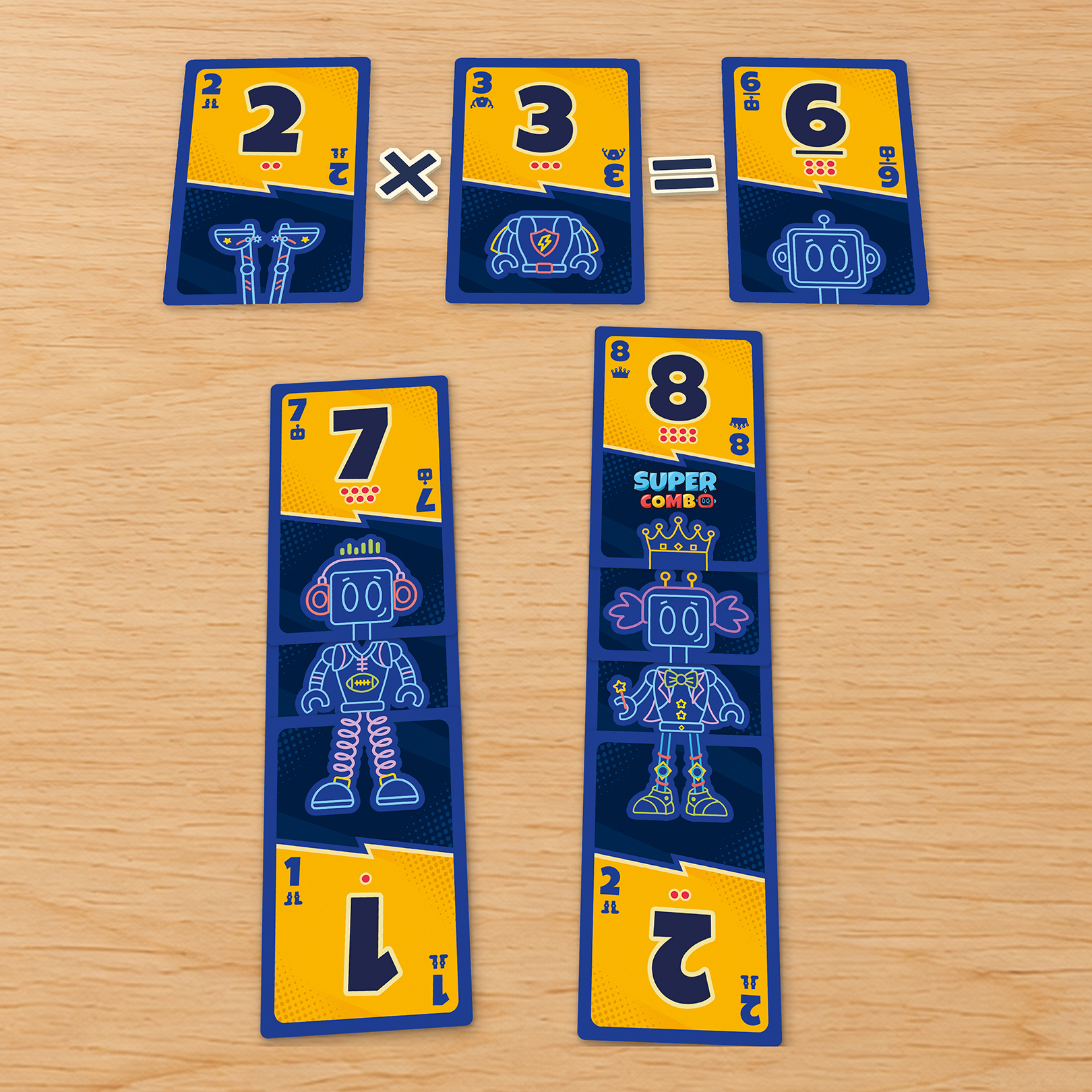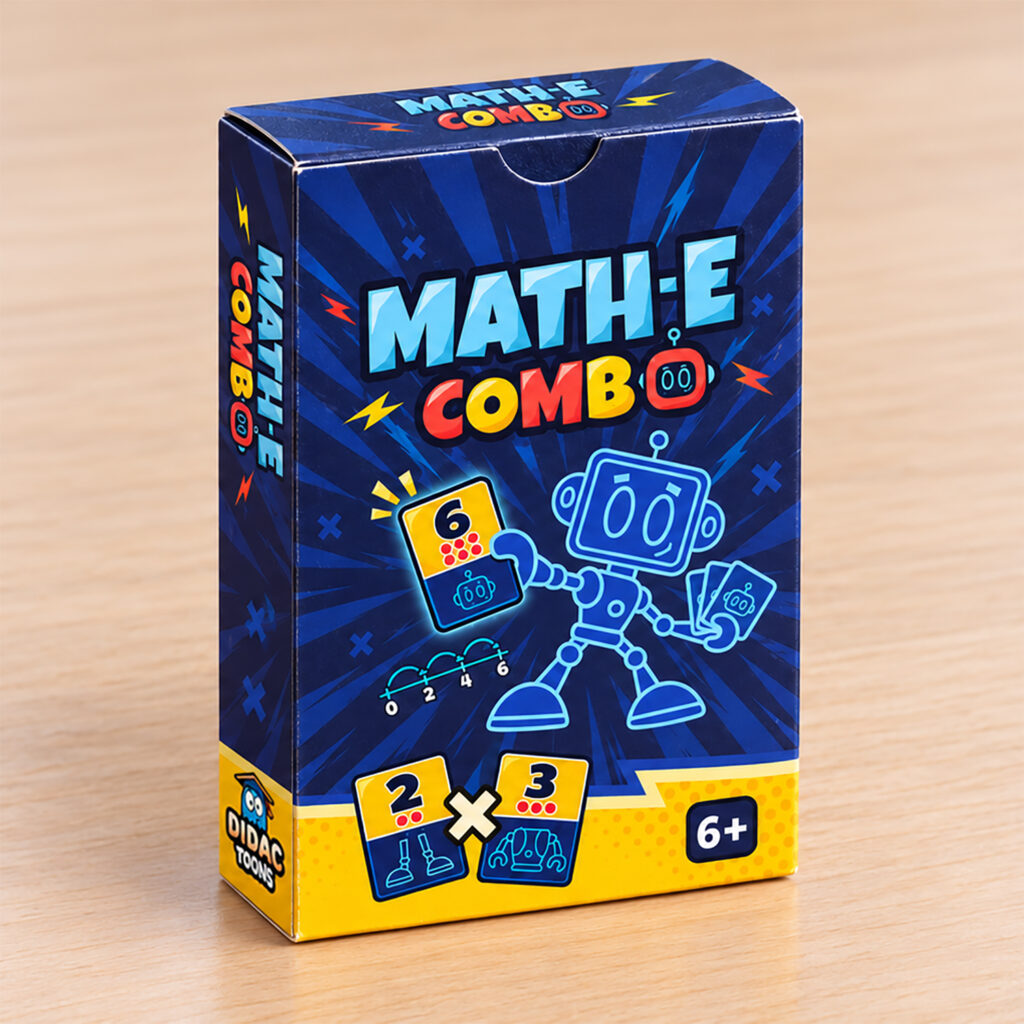
The challenge is to find the robot parts to make a Combo—or add a crown to create a Super Combo!
The game includes a help card with times tables that players can use to find combinations and check their answers as they play.
As children collect the cards they need to build Math-E, they practice their times tables and remember multiplication facts—often without even realizing they’re learning.
Children love building Math-E the robot and discovering new combinations.
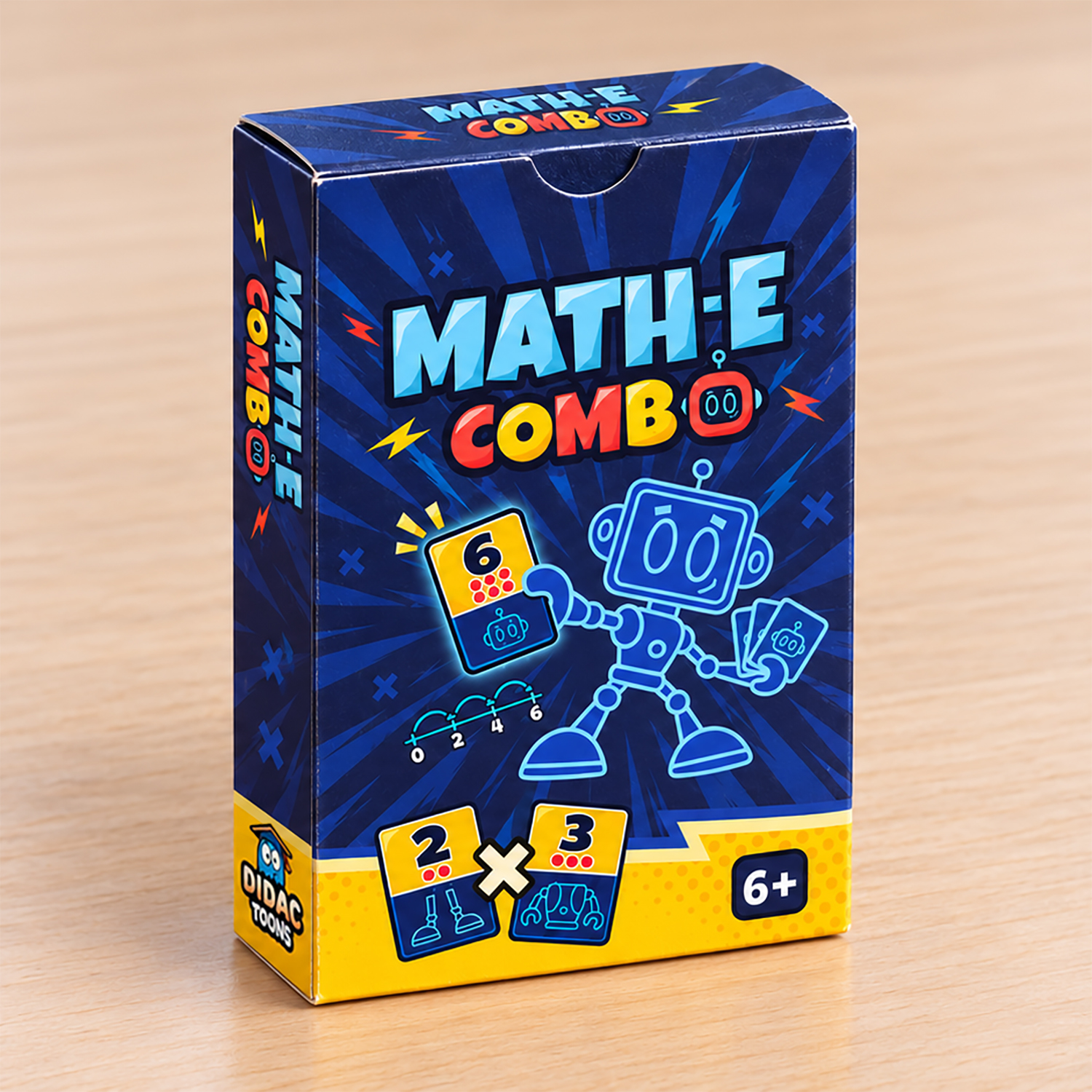
Math-E Combo helps children learn and practice times tables in the math classroom, whether they’re just getting started or need extra practice.
Math-E Combo brings more shared learning to the table.
The cards in the middle are shared: anyone can use them on their turn.
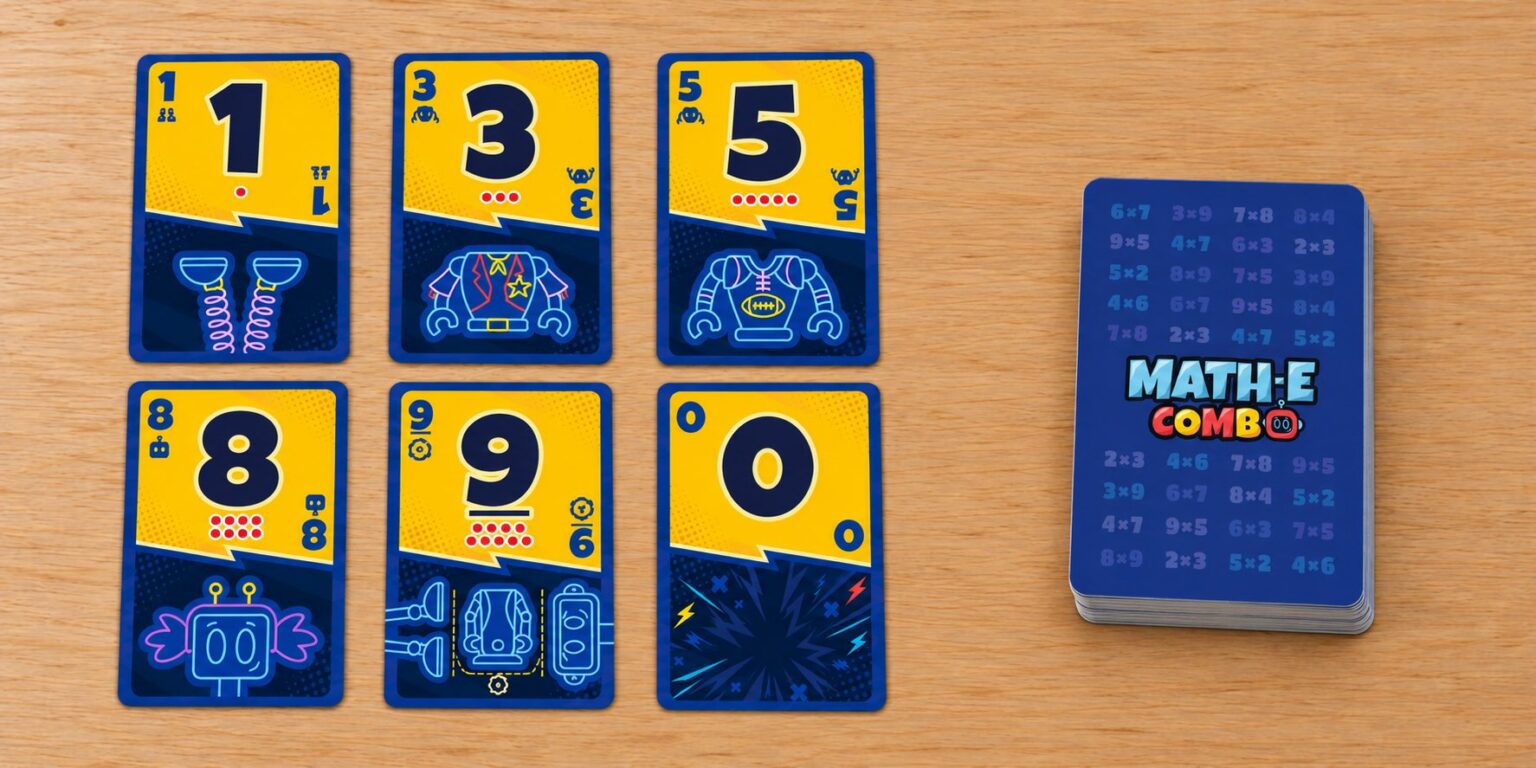
Example: 2 × 4 = 8. If you draw a 2, a 4 and a 7, and there is an 8 in the middle, you can use the 2, the 4 and the 8. You win those three cards and leave the 7 in the middle.
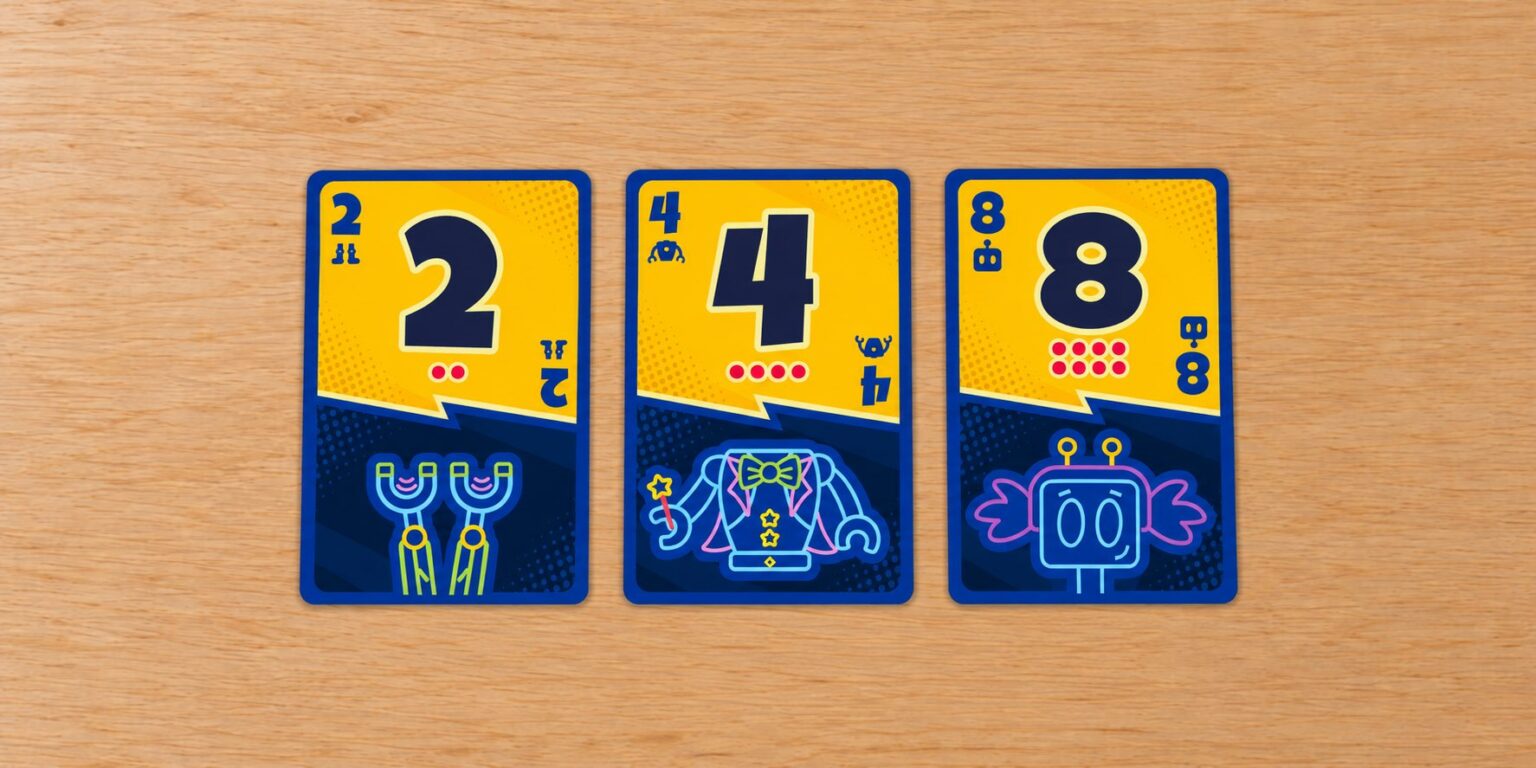
Place two cards side by side: one for the tens and one for the ones. For 3 × 4 = 12, use the 3, 4, 1 and 2 cards. The 1 followed by the 2 makes 12.
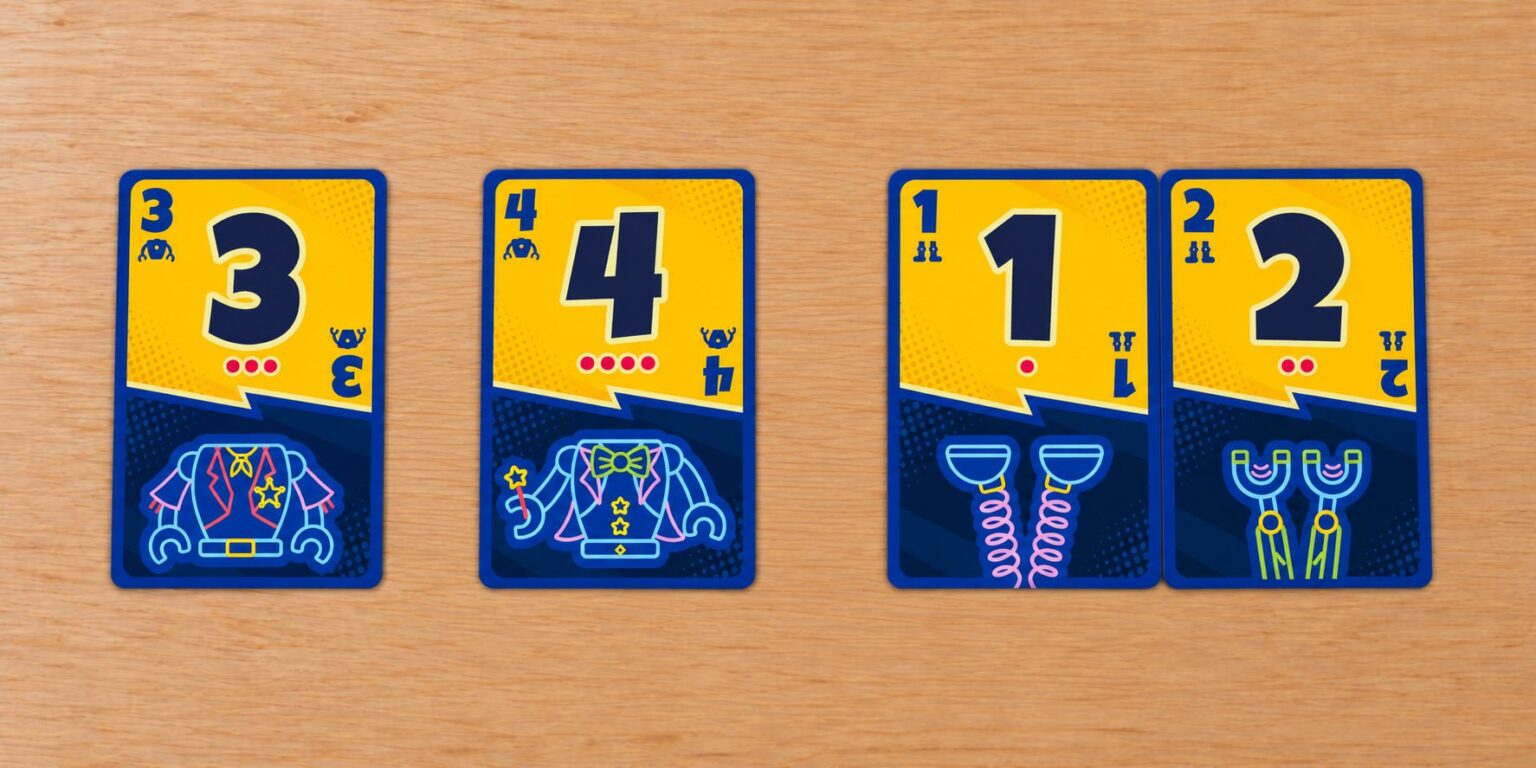
You win all the cards used, both the cards you drew and any cards you used from the middle. Keep them in front of you to build robots. Leave any cards you drew but did not use in the middle.
Place all 3 cards you drew face up in the middle and end your turn. You keep all the cards you won on earlier turns.
If there are fewer than 6 cards in the middle, add cards from the draw pile until there are 6 or the pile runs out. If there are already 6 or more, leave them all there.
Look at the robot parts on the cards you have won. Put them together to build robots and score points.
Combine three cards: one showing legs, one showing a body, and one showing a head.
You can use any legs, body and head. The parts don’t have to match—mix and match to create your own robots!
Build a robot with legs, a body and a head, then add a crown card. Your robot becomes a Super Combo and scores 8 points in total.
The wild card can stand for legs, a body or a head. You choose which part it replaces.
For example, if you have legs and a body, you can use the wild card as a head. You can also use it to complete a Super Combo robot and add its crown. The wild card cannot replace a crown.
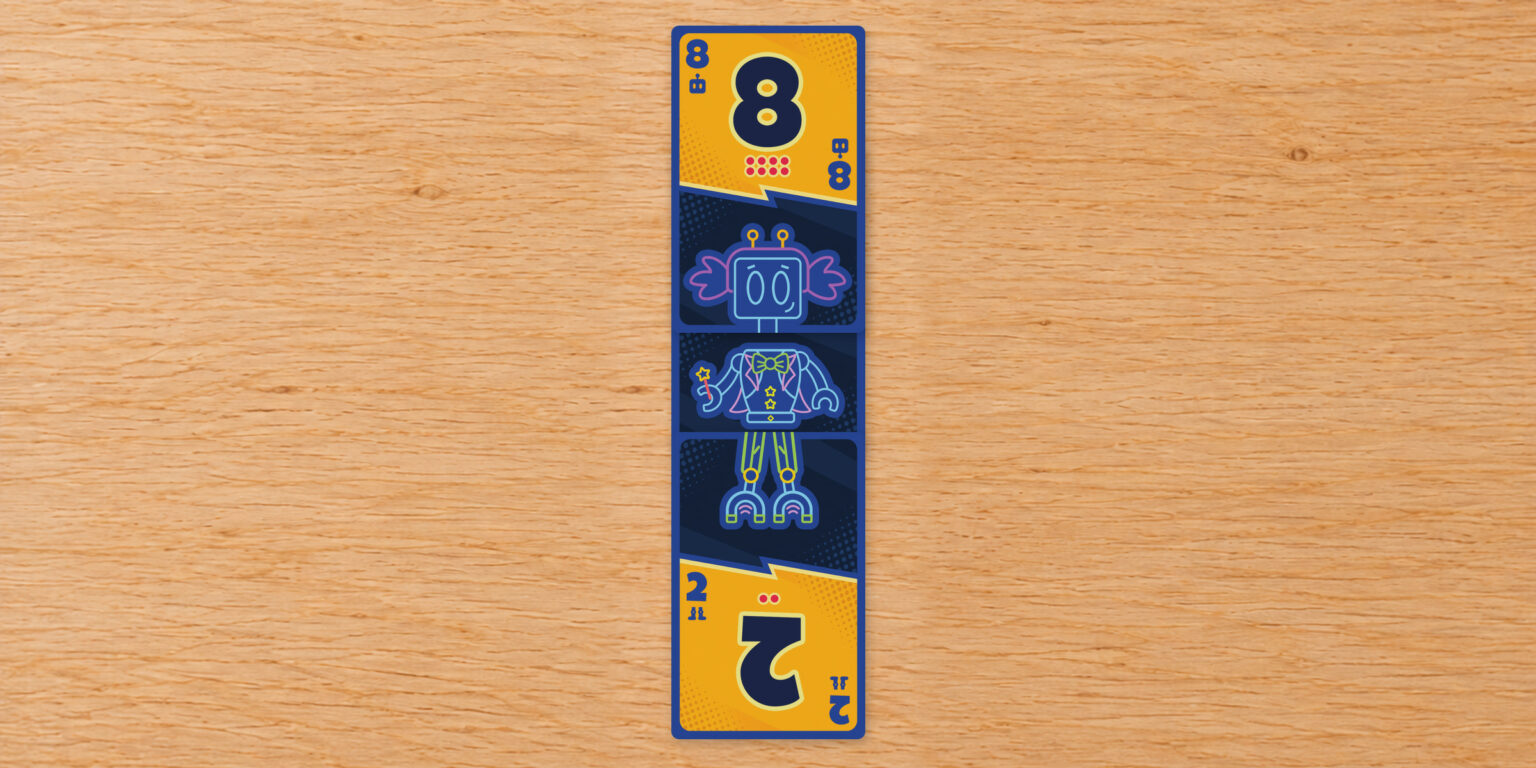
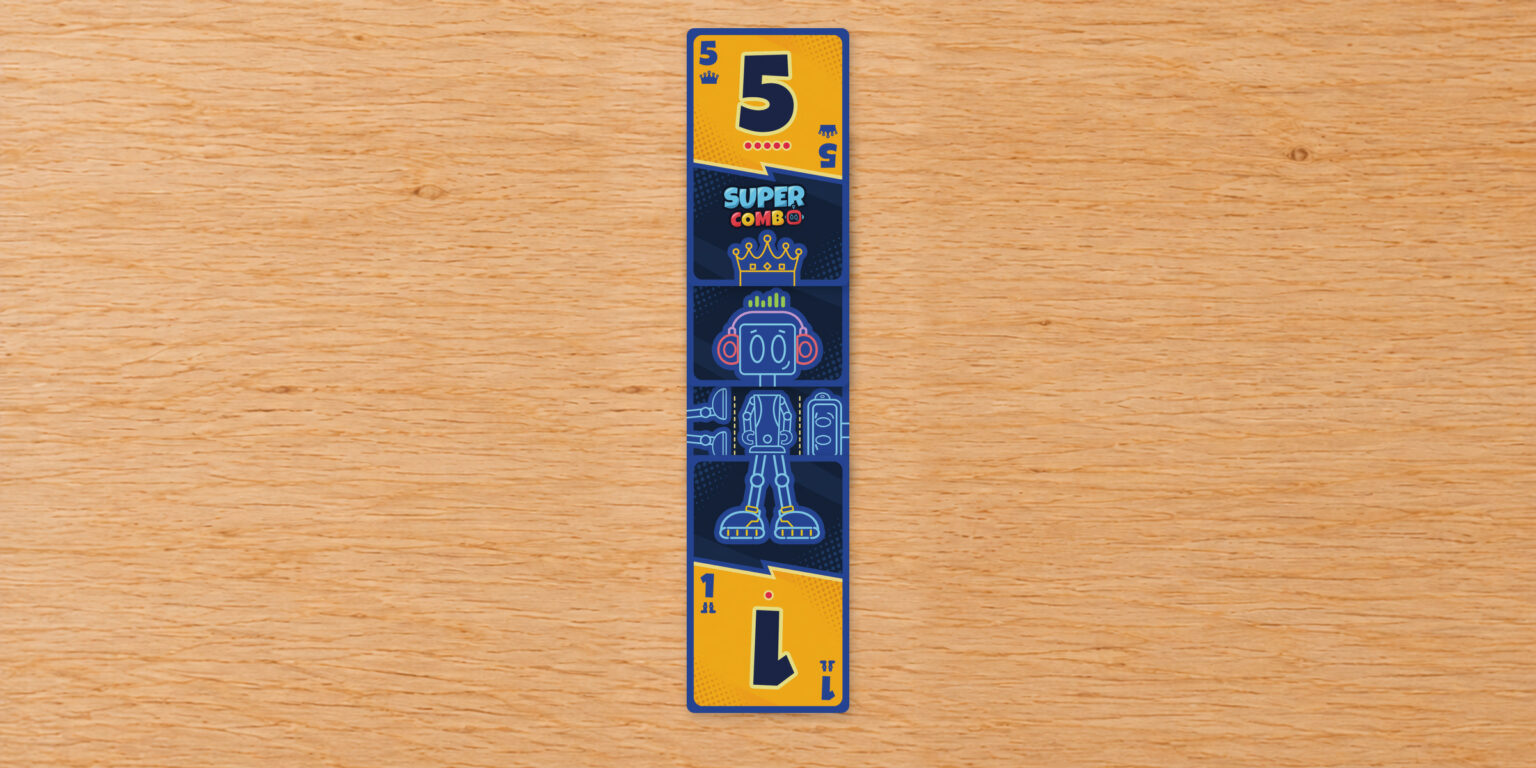
When a player draws the last cards from the pile, they finish their turn and the game ends. If fewer than 3 cards remain, they draw all the cards that are left.
Count each card only once. If a card is part of a robot, it is already included in that robot’s score.
One normal robot + one Super Combo + 3 leftover cards:
The cards in the middle are shared: anyone can use them on their turn.
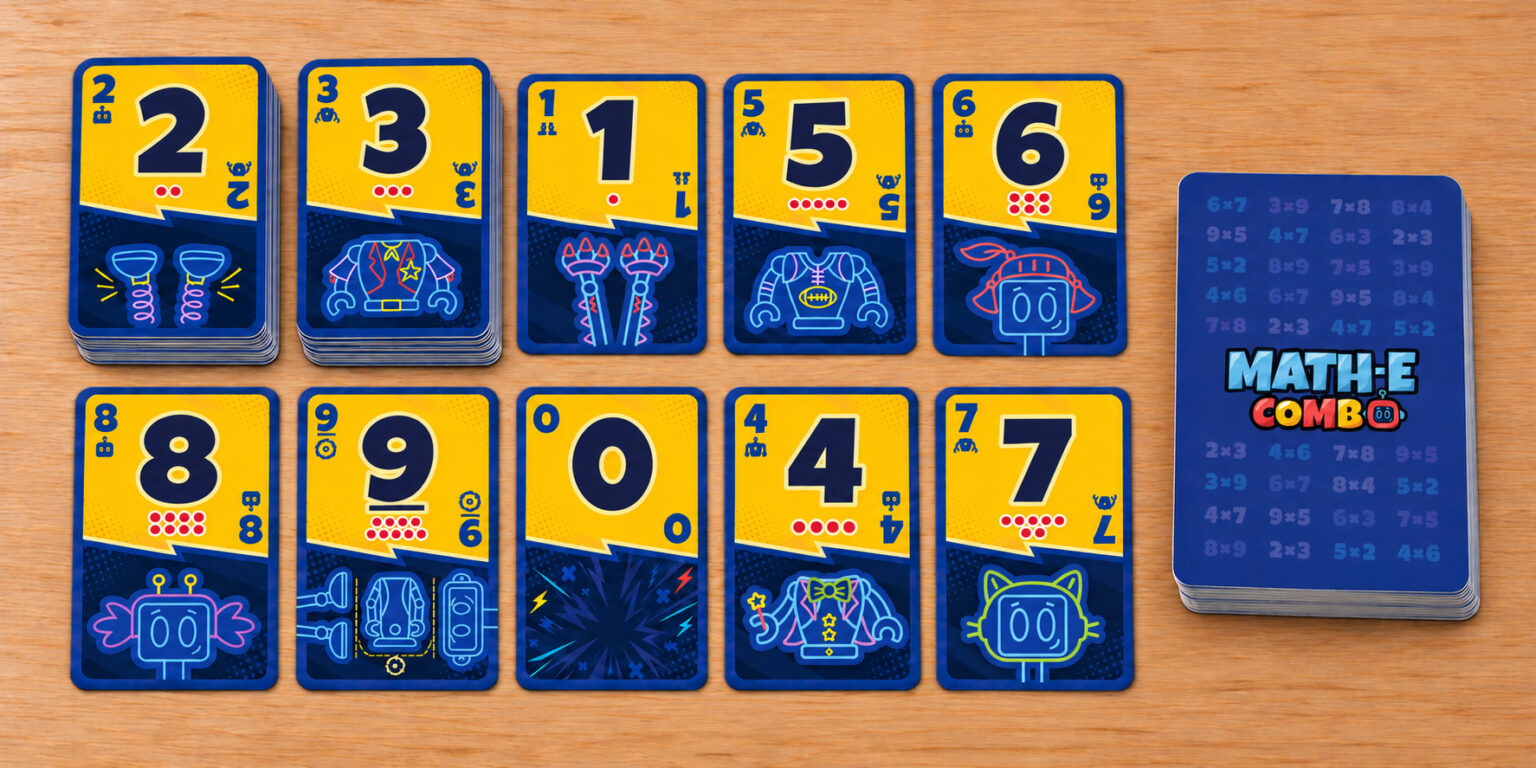
Example: 2 × 3 = 6. If you are practicing the 2 times table and there is a 2, a 3 and a 6 in the middle, you can use those cards and win them.
You can take two cards from the same mini pile to form your multiplication equation.
Example: 2 × 2 = 4. Use two cards from the pile of 2s and one card showing 4.
Place two cards side by side: one for the tens and one for the ones. For 3 × 4 = 12, use the 3, 4, 1 and 2 cards. The 1 followed by the 2 makes 12.
You win all the cards used. Keep them in front of you to build robots.
End your turn without winning any cards. You keep all the cards you won on earlier turns.
Reveal the next card in each mini pile you used. Then fill any gaps with cards from the draw pile until there are 10 cards showing in the middle again, or the draw pile runs out.
Look at the robot parts on the cards you have won. Put them together to build robots and score points.
Combine three cards: one showing legs, one showing a body, and one showing a head.
You can use any legs, body and head. The parts don’t have to match—mix and match to create your own robots!
Build a robot with legs, a body and a head, then add a crown card. Your robot becomes a Super Combo and scores 8 points in total.
The wild card can stand for legs, a body or a head. You choose which part it replaces.
For example, if you have legs and a body, you can use the wild card as a head. You can also use it to complete a Super Combo robot and add its crown. The wild card cannot replace a crown.
The game ends when there are no cards left in the middle showing the numbers of the times tables you chose, even if there are still other cards on the table or in the draw pile.
Count each card only once. If a card is part of a robot, it is already included in that robot’s score.
One normal robot + one Super Combo + 3 leftover cards:
The cards in the middle are shared: anyone can use them on their turn.
Example: 2 × 4 = 8. If you draw a 2, a 4 and a 7, and there is an 8 in the middle, you can use the 2, the 4 and the 8. You win those three cards and leave the 7 in the middle.
Place two cards side by side: one for the tens and one for the ones. For 3 × 4 = 12, use the 3, 4, 1 and 2 cards. The 1 followed by the 2 makes 12.
You win all the cards used, both the cards you drew and any cards you used from the middle. Check whether those cards include legs, a body and a head: if they do, build a robot now. If they also include a crown, you can make a Super Combo.
Keep your robot and any leftover cards in front of you. Cards that do not form a robot are worth 1 point each and cannot be used to build robots on later turns. Leave any cards you drew but did not use in the middle.
Place all 3 cards you drew face up in the middle and end your turn. You keep all the cards you won on earlier turns.
If there are fewer than 6 cards in the middle, add cards from the draw pile until there are 6 or the pile runs out. If there are already 6 or more, leave them all there.
Build each robot using only the cards used in one correct multiplication equation. You cannot use cards won on earlier turns or save pieces to complete a robot on a later turn.
Your equation must include three cards: one showing legs, one showing a body, and one showing a head. Put those cards together before ending your turn.
You can use any legs, body and head. The parts don’t have to match—mix and match to create your own robots!
To make a Super Combo, your equation must include legs, a body, a head and a crown card, all in the same play. Your robot scores 8 points in total. You cannot add a crown from an earlier or later turn.
The wild card can stand for legs, a body or a head. You choose which part it replaces, but it must be one of the cards used in that same equation.
For example, if your equation includes legs, a body and a wild card, use the wild card as a head to complete your robot. If that same equation also includes a crown, you can make a Super Combo. The wild card cannot replace a crown.
No. Use the cards you need and leave the others face up in the middle. You do not keep them for your next turn.
Yes. You can make your multiplication using cards you have just drawn, cards from the middle, or a mix of both.
No. You can only form one correct multiplication equation per turn.
Only the cards you used to form the correct equation. Keep the cards you win in front of you. Other players cannot use them again.
Leave them all there. Only add more cards when there are fewer than 6.
The game ends straight away. There is no extra turn: a player must be able to draw at least one card to take a turn.
Draw the cards that are left. Take your turn using those cards, cards from the middle, or a mix of both. As you have drawn at least one card, this is the last turn of the game.

This website uses first-party and third-party cookies.
A cookie or computer cookie is a small information file that is stored in your browser each time you visit our website.
The purpose of cookies is to store the history of your activity on our website so that, when you visit it again, it can identify you and configure its content based on your browsing habits, identity, and preferences. They also aim to ensure the proper functioning of the website.
Cookies can be accepted, rejected, deleted, and configured as desired. This can be done through the options available in this window or through your browser settings, as applicable.
In the event that you reject cookies, only technical or necessary cookies for the operation of the website will be used.
More information can be found in the "COOKIES POLICY" section of our website.